Cover Generator
A cover-creation tool for self-publishing authors on Litres. Most aren't designers and can't hire one, so it had to make a good cover almost impossible to get wrong.
A cover-creation tool for self-publishing authors on Litres. Most aren't designers and can't hire one, so it had to make a good cover almost impossible to get wrong.


YEAR
2022
ROLE
Concept and design
SERVICES
Concept, product design, UX/UI
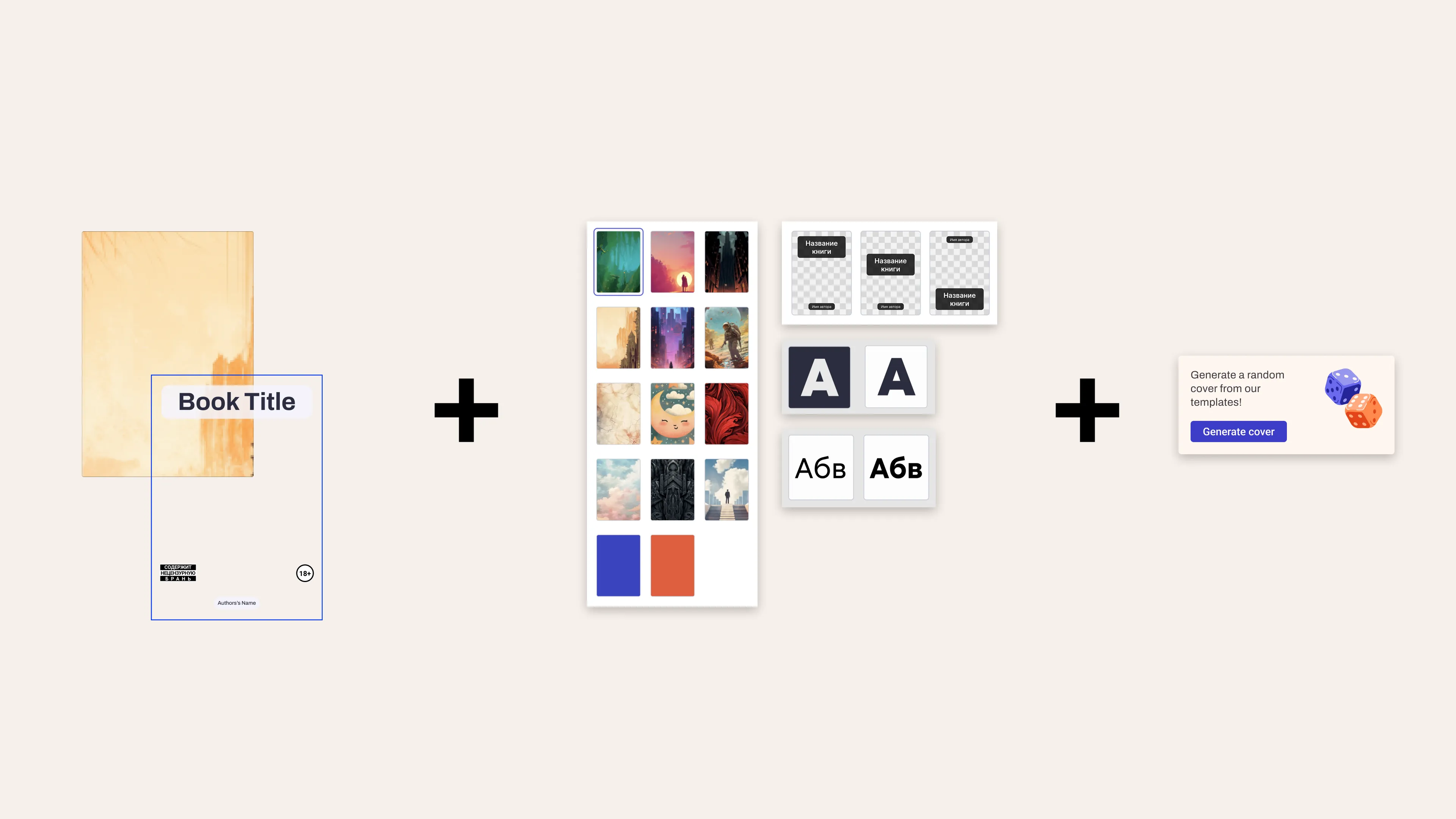
The tool is deliberately limited: pick a template, an image, a light or dark font, and one of three layouts. That's it. Our users are self-publishing authors, mostly not designers and often without the budget to hire one, so the goal was a tool that produces a decent cover for anyone and is hard to mess up. Authors could also upload a finished cover, or just a background, which turned out to be surprisingly common.
The hard part wasn't the engine that generated covers, it was the full editor interface, which was new to our design system and would have taken real time to build. So I shipped a stripped-down first version: just a button that generated a cover, plus the option to upload your own background. But I designed it as a foundation, not a throwaway. The structure could take new settings, templates, and a planned AI background-generation feature later without rework. (The stock backgrounds were already Midjourney-generated, so AI was in the picture from the start.)
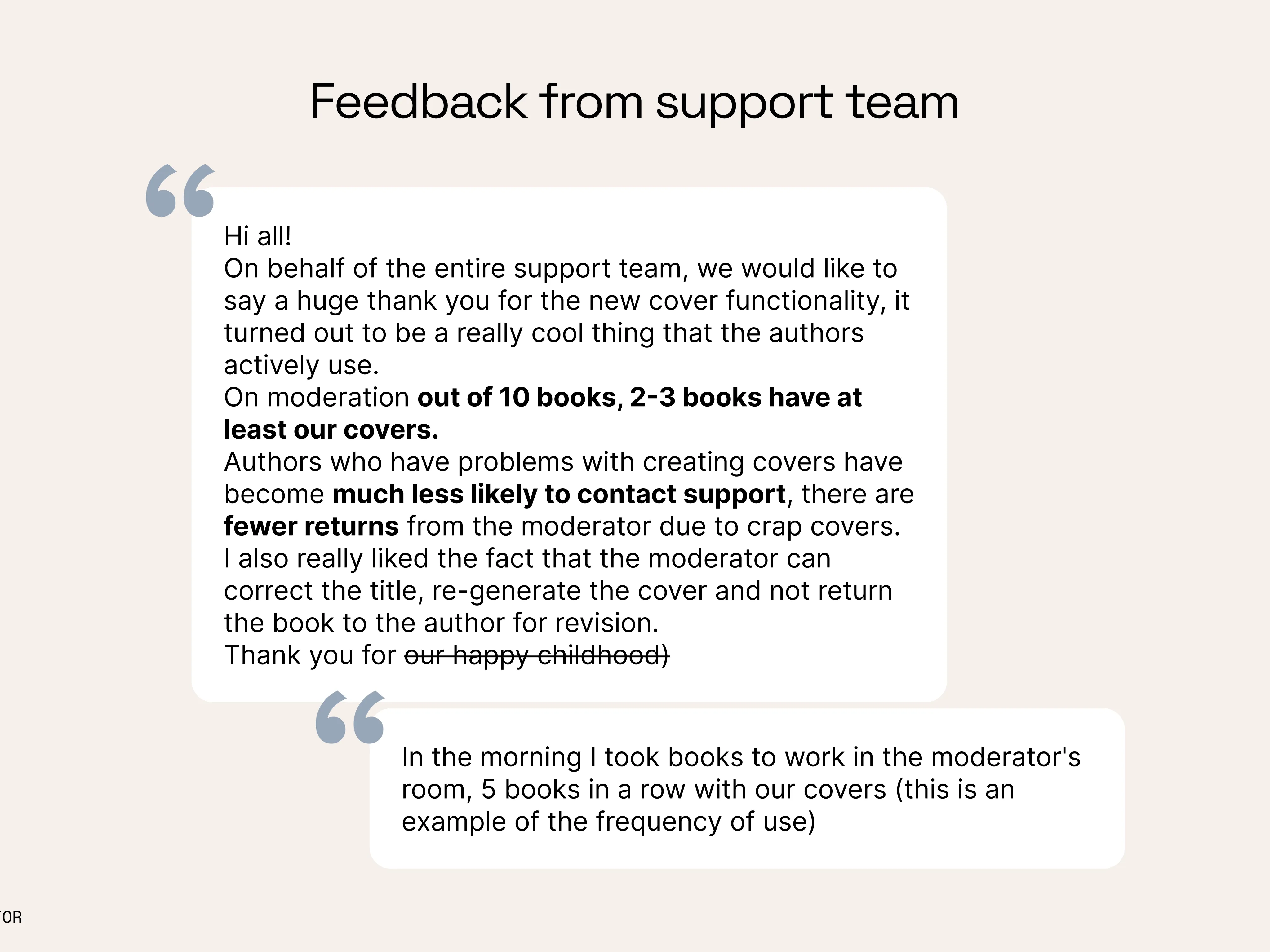
Adoption was quick and real. Before long, the support team was seeing roughly 2 to 3 of every 10 books come through with a generator-made cover. With the approach proven, we built the full editor on top of that foundation.


A cover-creation tool for self-publishing authors on Litres. Most aren't designers and can't hire one, so it had to make a good cover almost impossible to get wrong.
YEAR
2022
ROLE
Concept and design
SERVICES
Concept, product design, UX/UI
The tool is deliberately limited: pick a template, an image, a light or dark font, and one of three layouts. That's it. Our users are self-publishing authors, mostly not designers and often without the budget to hire one, so the goal was a tool that produces a decent cover for anyone and is hard to mess up. Authors could also upload a finished cover, or just a background, which turned out to be surprisingly common.
The hard part wasn't the engine that generated covers, it was the full editor interface, which was new to our design system and would have taken real time to build. So I shipped a stripped-down first version: just a button that generated a cover, plus the option to upload your own background. But I designed it as a foundation, not a throwaway. The structure could take new settings, templates, and a planned AI background-generation feature later without rework. (The stock backgrounds were already Midjourney-generated, so AI was in the picture from the start.)
Adoption was quick and real. Before long, the support team was seeing roughly 2 to 3 of every 10 books come through with a generator-made cover. With the approach proven, we built the full editor on top of that foundation.
A cover-creation tool for self-publishing authors on Litres. Most aren't designers and can't hire one, so it had to make a good cover almost impossible to get wrong.
YEAR
2022
ROLE
Concept and design
SERVICES
Concept, product design, UX/UI
The tool is deliberately limited: pick a template, an image, a light or dark font, and one of three layouts. That's it. Our users are self-publishing authors, mostly not designers and often without the budget to hire one, so the goal was a tool that produces a decent cover for anyone and is hard to mess up. Authors could also upload a finished cover, or just a background, which turned out to be surprisingly common.
The hard part wasn't the engine that generated covers, it was the full editor interface, which was new to our design system and would have taken real time to build. So I shipped a stripped-down first version: just a button that generated a cover, plus the option to upload your own background. But I designed it as a foundation, not a throwaway. The structure could take new settings, templates, and a planned AI background-generation feature later without rework. (The stock backgrounds were already Midjourney-generated, so AI was in the picture from the start.)
Adoption was quick and real. Before long, the support team was seeing roughly 2 to 3 of every 10 books come through with a generator-made cover. With the approach proven, we built the full editor on top of that foundation.